Understanding the Relationship Between Posture and the Feet Through Data

Care About Your Posture? Start With Your Feet.
“I want to improve my posture.”
When people think this, most of them do the same things:
They straighten their back.
They open their chest.
They tuck their chin.
None of these are wrong.
But they do not address the root of the problem.
Why?
Because posture is not determined by conscious effort alone.
It is a phenomenon created by body structure and weight distribution.
And the starting point of that structure is the feet.
The Body Is Like a Stack of Blocks. Misalignment Starts From the Bottom.
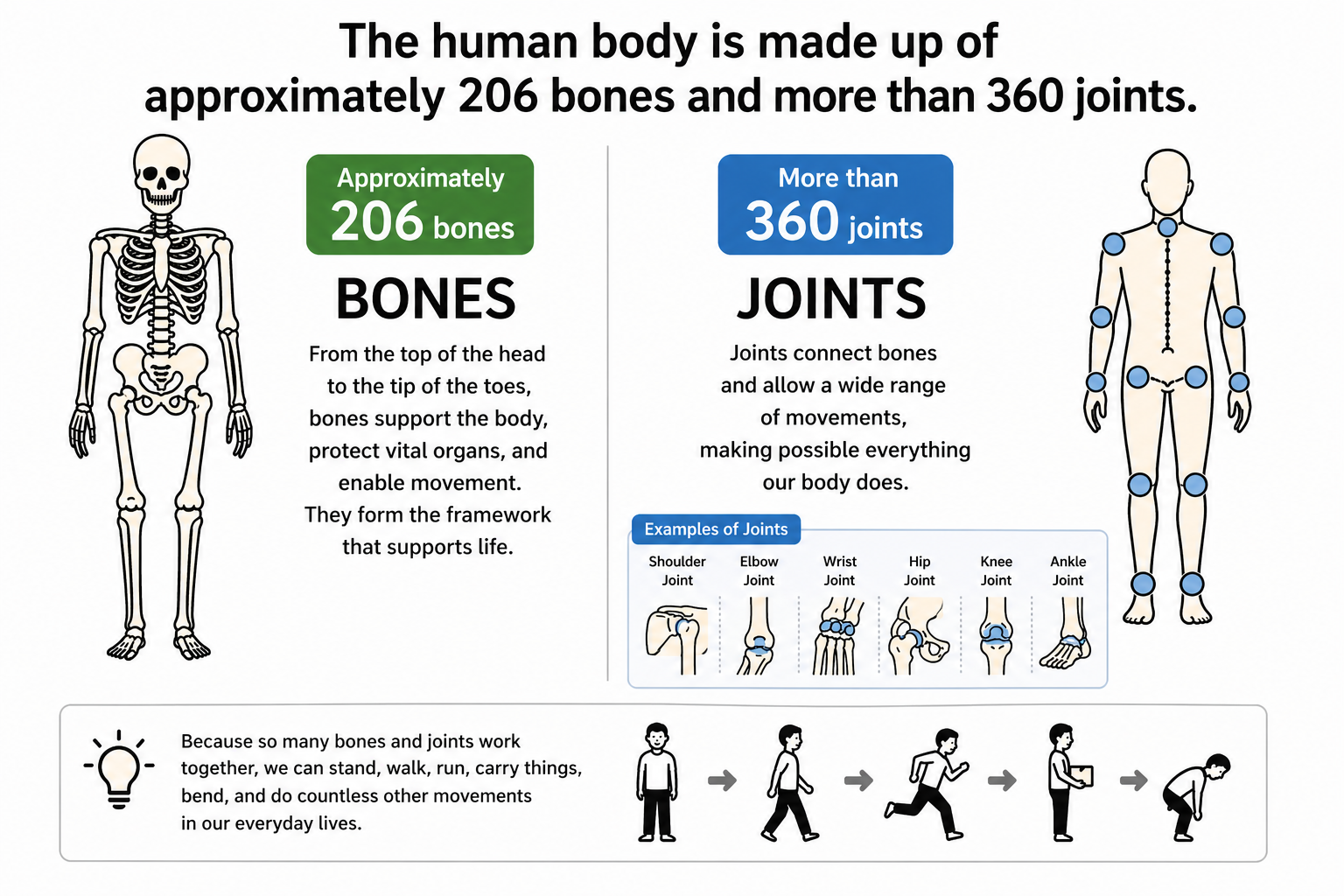
The human body is made up of around 206 bones and more than 360 joints.
From a mechanical perspective, this makes the body a typical multi-joint structure.
The key feature of this structure is simple:
A small misalignment in the lower body can become amplified in the upper body.
For example:
Foot pronation or supination
—a shift of around 2 to 5 degrees—
↓
Internal or external rotation of the tibia
↓
Pelvic tilt
—around 3 to 7 degrees—
↓
Changes in the spinal curve
↓
Forward movement of the head
—around 2 to 5 cm—
In other words:
A shift of just a few millimeters at the feet can eventually become a posture change measured in centimeters.
This is not unusual in clinical practice or motion analysis.
The Idea That Posture Is Influenced “50% From Above and 50% From Below”
There is an important concept when discussing posture.
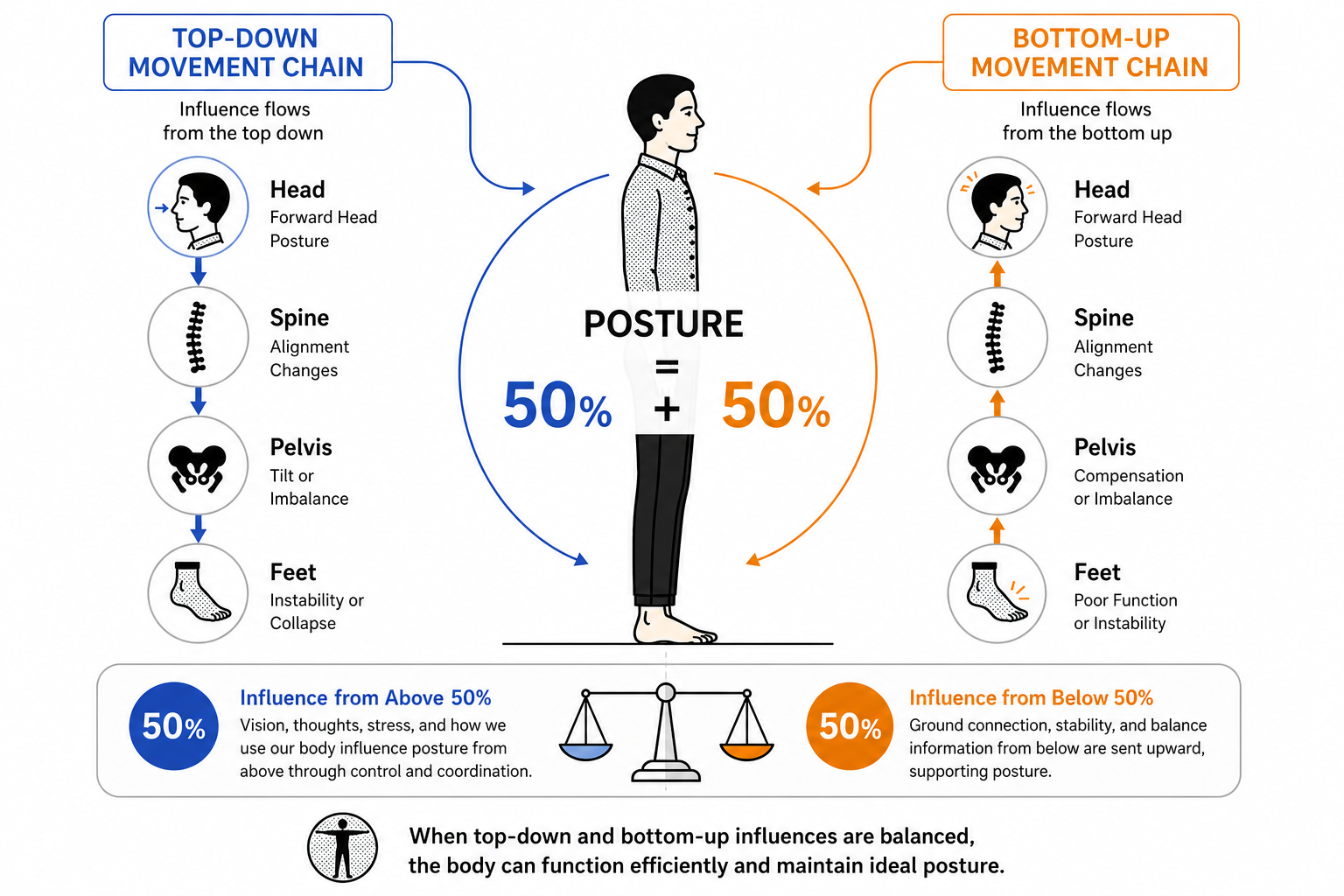
It is the idea of the ascending kinetic chain and the descending kinetic chain.
Ascending Kinetic Chain
This refers to influence traveling from the feet upward.
Example:
Foot collapse
→ pelvis
→ spine
→ head
Descending Kinetic Chain
This refers to influence traveling from the head downward.
Example:
The head moves forward
→ spine
→ pelvis
→ feet
In practical settings, this balance is often described as:
“Posture is influenced 50% from above and 50% from below.”
Of course, this is not a strictly quantified scientific formula.
However, in practice, certain tendencies are often seen:
People who mainly do desk work
→ tend to be more affected by the descending chain, or influence from above.
People who stand for long hours or are physically active
→ tend to be more affected by the ascending chain, or influence from below.
The important point is this:
Posture is not fixed by only one side. It becomes fixed through the interaction between the upper body and lower body.
Among all these factors, the feet are especially important because they are both:
the starting point of the body’s structure,
and an area that is relatively easy to assess and improve.
That is why, when trying to improve posture, it is logical to begin by looking at the feet.
Which Has a Stronger Effect: Ascending or Descending?
Posture is not determined by theory alone.
It is also shaped by everyday habits.
Let’s look at which daily habits create collapse from above and which create collapse from below.
Daily Habits That Affect the Ascending Kinetic Chain
Feet → Upper Body
This is the type of postural collapse that begins at the feet.
Standing and walking patterns have a major impact here.
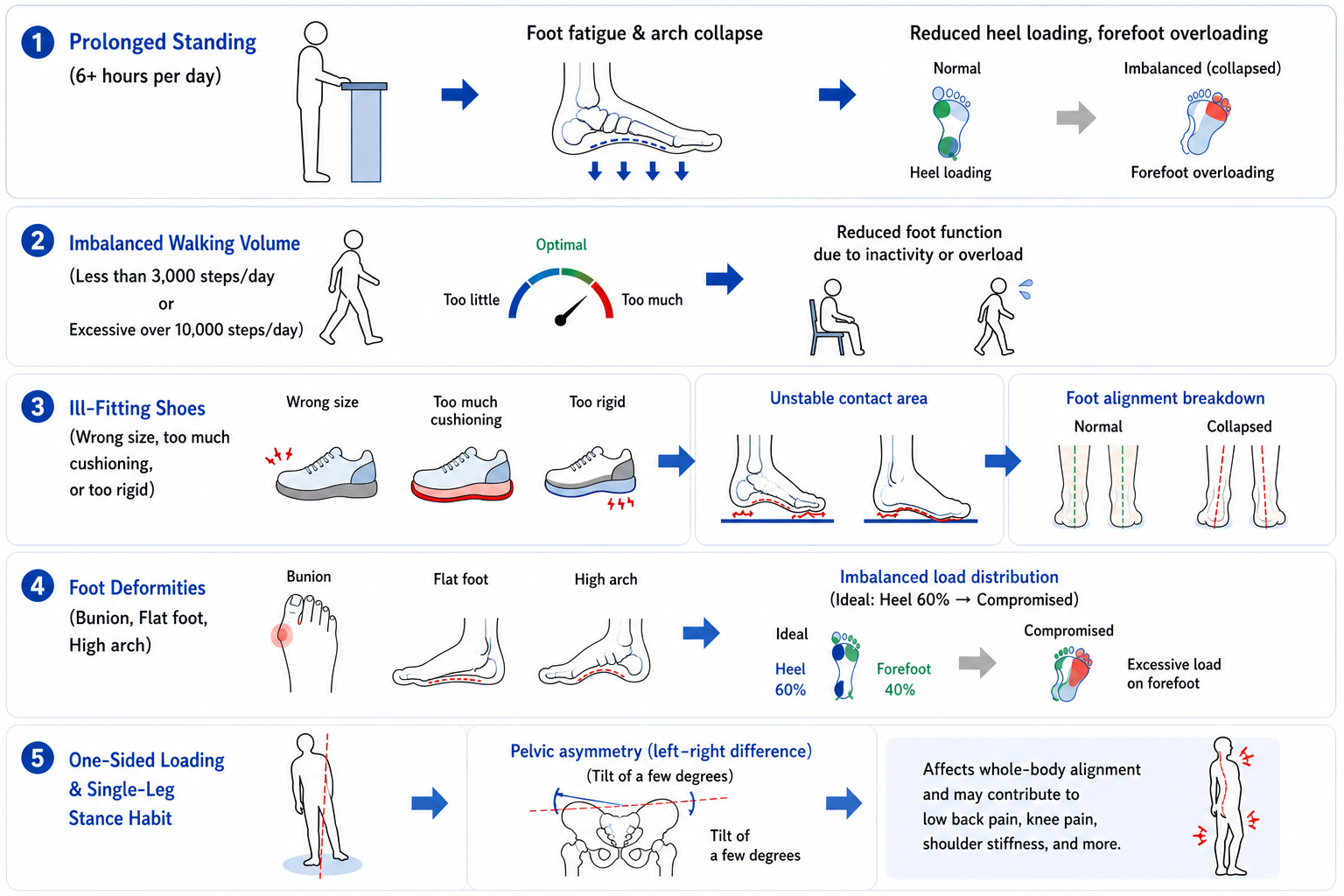
Main causes include:
Standing for long hours
For example, more than 6 hours per day.
This can lead to foot fatigue and a lowered arch.
As a result, heel loading decreases and weight shifts excessively toward the forefoot.
Too little or too much walking
For example, fewer than 3,000 steps per day, or more than 10,000 steps with excessive load.
Both inactivity and overload can reduce foot function.
Shoes that do not fit properly
This includes shoes that are the wrong size, too cushioned, or too stiff.
Poor footwear can make ground contact unstable and disrupt foot alignment.
Foot deformities
Examples include bunions, flat feet, or high arches.
These can create uneven weight distribution.
The ideal reference point is often considered to be around 60% of body weight on the heels, but this balance can collapse.
Habitually standing on one side
Putting more weight on one leg or always standing with the same leg dominant can create left-right differences in the pelvis.
Even a tilt of just a few degrees can matter.
As a result, the body may experience:
Pelvic tilt of around 3 to 7 degrees
↓
Changes in the spinal curve
↓
Head position displacement of around 2 to 4 cm
Daily Habits That Affect the Descending Kinetic Chain
Head → Feet
This is the type of postural collapse that begins from the head or upper body.
For many modern people, this pattern is more dominant.
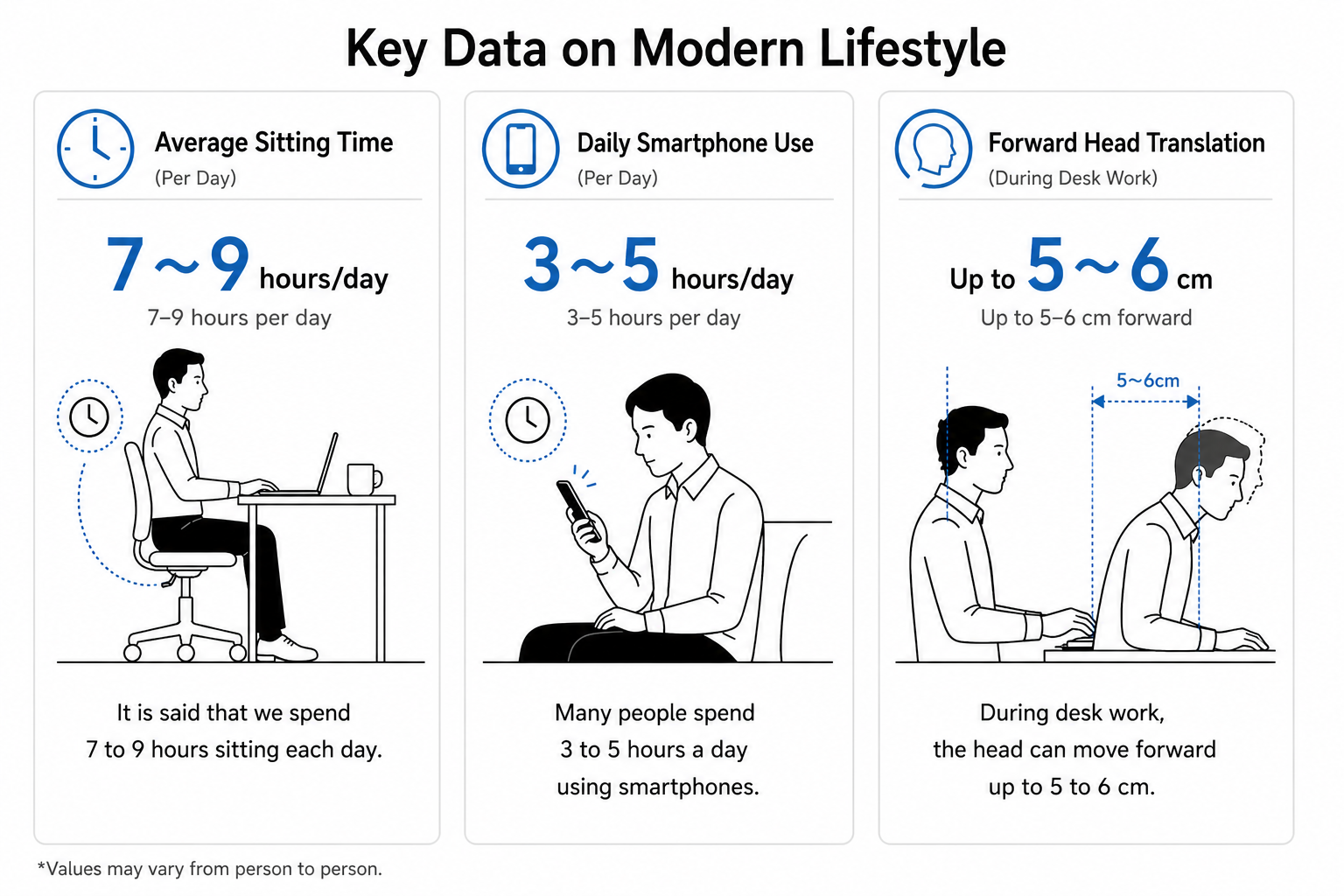
Main causes include:
Smartphone use
Average usage of 3 to 5 hours per day can contribute to the head moving forward by around 2 to 5 cm.
Long hours of sitting
Sitting for around 7 to 9 hours per day can cause the pelvis to tilt backward, reducing the natural curve of the spine.
Leaning forward during computer work
The head weighs around 4 to 6 kg.
When it shifts forward, the load on the neck can increase to around 2 to 3 times its normal level, equivalent to roughly 15 kg of stress.
A low monitor position or laptop use
This can change the natural curve of the cervical spine by around 15 to 45 degrees.
Lack of exercise
Less than 150 minutes of exercise per week can reduce the function of the muscles responsible for maintaining posture.
As a result, the body may experience:
Forward head posture
—around 2 to 5 cm forward—
↓
Loss of the natural cervical curve
↓
Loss of the spine’s natural S-shaped curve
↓
Changes in pelvic tilt
↓
Rotation of the femur
↓
Changes in tibial angle
↓
Changes in weight distribution through the feet
The Important Point: Most People Have Both Problems
This is the key.
Many modern people have both:
too much sitting, which creates descending-chain problems,
and lack of movement or poor walking habits, which create ascending-chain problems.
In other words:
The body is being pulled out of alignment from both above and below.
Why It Makes Sense to Start With the Feet
Both ascending and descending influences exist.
But the feet have three important characteristics:
They are the starting point of the body’s structure.
They are easy to measure using data such as center of gravity, contact area, and left-right balance.
Changes in the feet can affect the entire body.
That is why, in practice, the following order is often more reproducible:
First assess the feet.
Then adjust the upper body.
This approach makes posture improvement more measurable and more consistent.
Posture Is Not About Appearance. It Is About Alignment.
Posture is not simply about how the body looks.
It is determined by a continuous chain of small errors in joint position.
There are two basic movements in joint motion:
Rolling
and
gliding
In a healthy joint, these two movements occur together.
This allows the joint to move while maintaining proper contact surface area.
However, when problems occur, such as:
reduced range of motion,
or increased muscle stiffness,
the following can happen:
Gliding motion decreases by around 20 to 40%
↓
Joint contact area decreases
↓
The body begins to rely on point-based support
↓
Joint misalignment occurs
The misalignment at each joint may only be a few millimeters or a few degrees.
But when the error passes through multiple joints, such as the ankle, knee, hip, and spine, the accumulated error can become several centimeters.
Sway Becomes More Obvious Higher Up
The same thing happens in earthquakes:
The higher you go, the more the sway is amplified.
The human body works in a similar way.
A small instability at the feet
↓
becomes amplified in the upper body
↓
and finally becomes visible at the head as poor posture.
That means problems such as:
a rounded back,
or the head sticking forward,
are not the root cause.
They are the result.
The feet are not just a foundation.
They work like a suspension system that handles:
shock absorption
—during walking, the load can reach around 1.2 to 1.5 times body weight—
and balance control.
When the feet do not function well, the upper body cannot remain stable.
The Standard Weight Distribution Is 60% on the Heels
An ideal weight distribution is often described as:
Heel: 60%
Ball of the big toe: 30%
Ball of the little toe: 10%
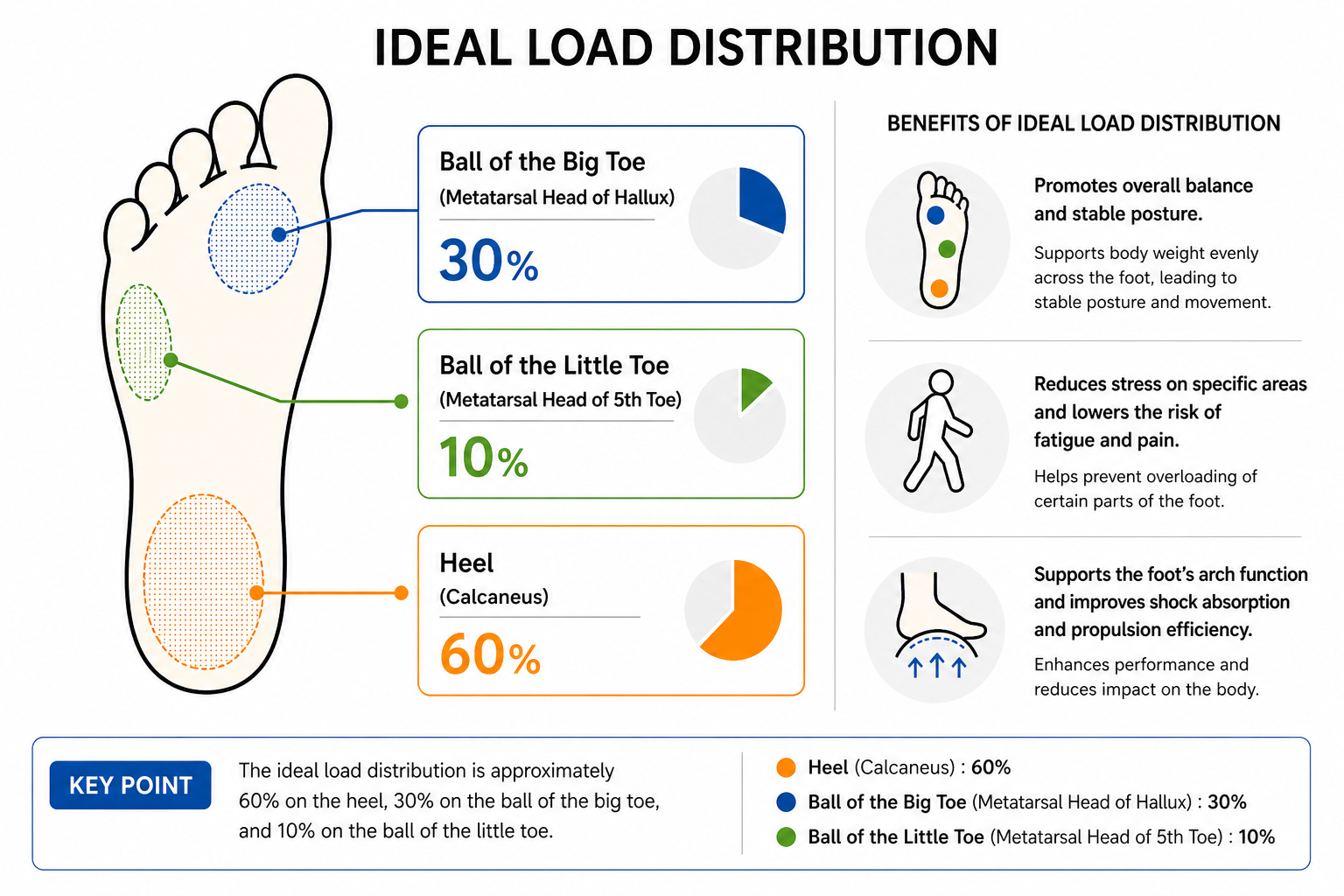
However, actual measurements often show that:
around 70 to 80% of people are forefoot-dominant, meaning their weight shifts toward the toes,
and the center of gravity is displaced forward by an average of 2 to 4 cm.
This shift can lead to:
Forward head movement of 2 to 5 cm
Increased neck load of around 3 times
A decrease in balance ability of around 15 to 30%
The important point is this:
Almost all of this happens unconsciously.
Posture is not determined by willpower.
If You Want to Improve Posture, Focus on These Three Areas
Posture may seem complex, but structurally it can be broken down into three areas.
1. The Feet: Structure
Key points include:
arch height
—around 10 to 20 mm is often considered a normal range—
flexibility
presence or absence of deformity
2. The Pelvis: Function
Key points include:
anterior pelvic tilt
—around 10 to 15 degrees can be used as a reference—
posterior tilt mobility
ability to maintain a neutral position
3. The Upper Body: Control
Key points include:
forward head movement
—ideally within 0 to 2 cm—
scapular mobility
stability
For Now, Start by Looking at Your Feet
To summarize:
Posture is difficult to change through conscious effort alone.
A misalignment of just a few millimeters in the feet can affect the entire body.
A forward shift in the center of gravity of 2 to 5 cm is common.
The load on the head and neck can increase by around three times.
Roughly half of postural problems can be explained by what is happening at the feet.
In other words:
Posture is not something you directly control.
Posture is the result of how the body is arranged.
The First Thing to Do
There is one simple place to begin:
Measure your feet.
Check:
center of gravity,
ground contact balance,
left-right differences.
Simply understanding these factors quantitatively can dramatically improve the accuracy of posture correction.
If you want to change your posture,
look down before you look up.
This is not just a feeling.
It is something that can be explained through data.