Why do people who move more tend to be happier? — what the data reveals

Starting from the premise that humans can be measured
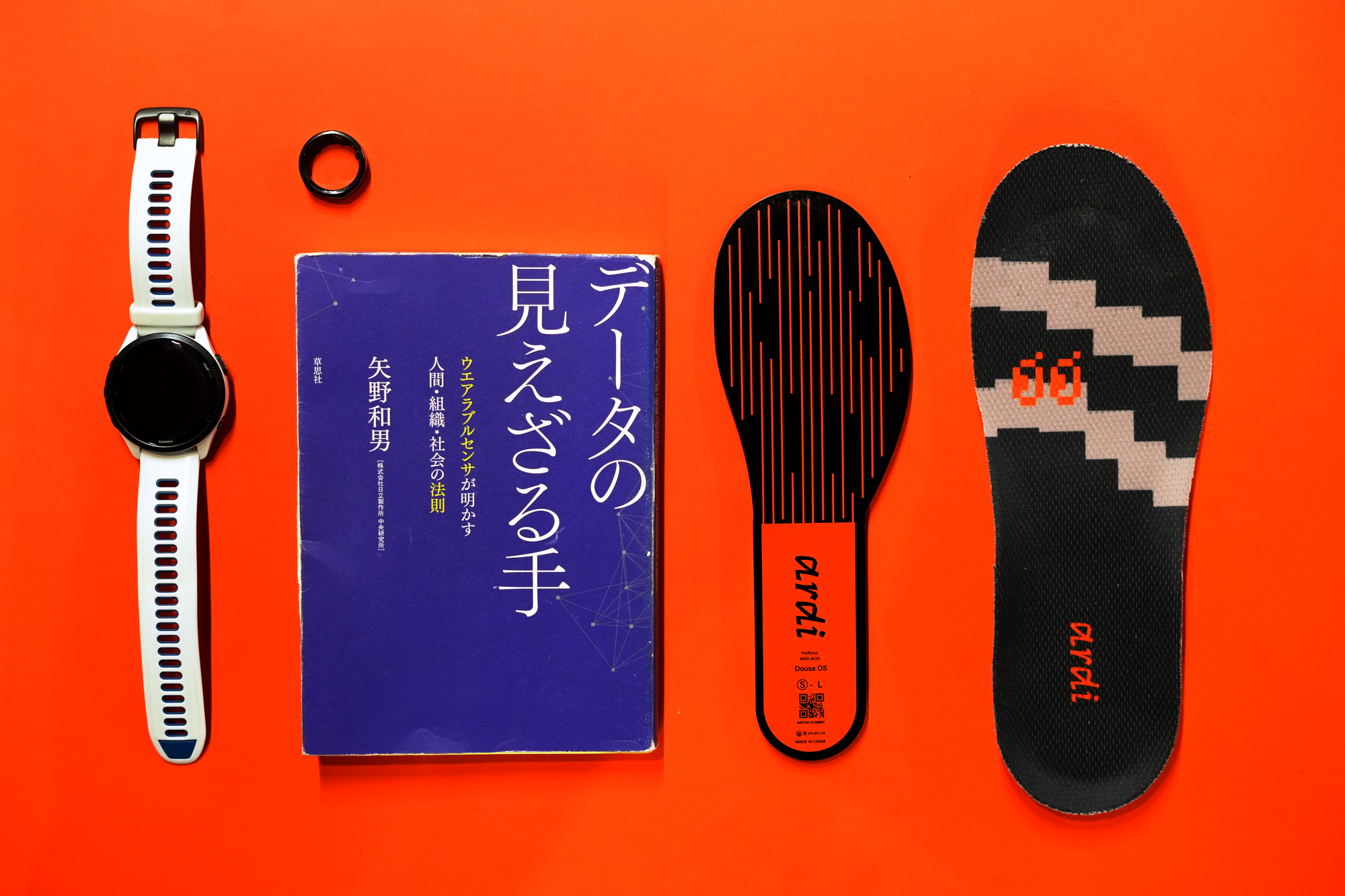
The first thing I felt after reading The Invisible Hand of Data by Kazuo Yano (2014)
was that it stands on a very strong premise:
human behavior and states can be understood through data.
Using wearable sensors, it measures movement, conversation, and contact frequency.
From there, even vague concepts like organizational atmosphere or happiness
begin to reveal patterns.
It sounds simple, but it’s actually quite radical.
It attempts to turn something inherently ambiguous—humans—into something measurable.
At the same time,
I felt a strong sense of possibility.
If humans can be measured,
maybe we can intentionally design better states.
Happiness is driven by behavior, not just mindset
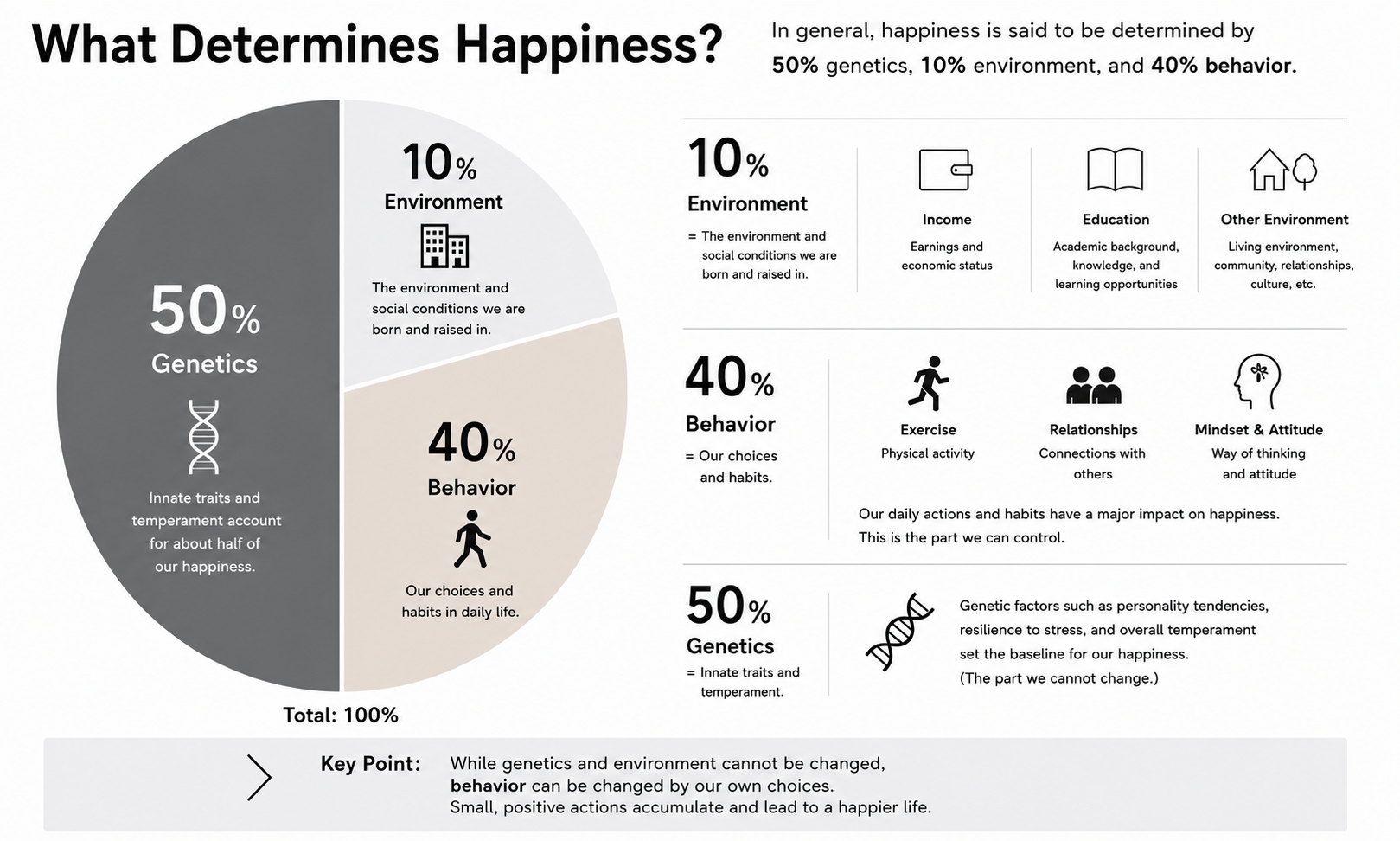
What stood out most was how the book defines happiness.
It’s often said that happiness is influenced by:
- ~50% genetics
- ~10% environment
- ~40% behavior
More important than the numbers
is the focus on behavior.
People who:
- move frequently
- interact with others
- live with a certain rhythm
tend to show higher levels of happiness and productivity.
In other words:
happiness is shaped less by how you think,
and more by how you move.
This may feel counterintuitive.
But that’s exactly why it’s valuable.
And this idea shouldn’t stop at the individual level.
If we can collectively understand
what kinds of actions create good states,
that’s where culture begins.
Luck is amplified by volume of action
Another key insight is about luck.
We tend to explain success through ability or effort.
But in reality, chance—encounters, timing—plays a major role.
The important point is:
luck is not entirely random.
People who move more:
- increase the number of encounters
- increase the number of trials
- increase exposure to chance
In short,
they increase the probability of meeting luck.
This may be the core idea:
It’s not that active people are happier because they are positive.
They are happier because they encounter luck more often.
And this applies to organizations as well.
Environments where:
- trying new things is encouraged
- interaction happens naturally
create a circulation of luck.
On the other hand,
in static and isolated environments,
luck rarely emerges.
Luck is not personality. It is created by environment and behavior.
Can wearables make people happier?
So, can wearables that measure behavior make people happier?
My answer is:
not directly—but they play a critical role.
Wearables don’t change your state.
They reveal misalignment.
- You think you’re active, but you’re not
- You think you’re connected, but you’re isolated
These gaps are hard to notice on your own.
Data makes them visible.
But visibility alone changes nothing.
Without changing behavior, reality stays the same.
That’s why the real value of wearables
is not just personal—it’s collective.
They help define and share
what a “good state” actually is.
And that’s essential for building culture.
Performance comes from relationships, not individuals
Another important message:
performance is not driven by individuals, but by relationships.
It’s not about who is talented,
but how people are connected.
The volume of interaction
and the density of networks
directly impact outcomes.
This feels both uncomfortable and convincing.
Most organizations try to optimize individual ability.
But in reality,
connections drive results.
If that’s the case,
what we evaluate should also change.
Not just outcomes, but:
- actions that build relationships
- movements that connect people
Relationships don’t just happen.
They are designed.
Does data lead to optimization—or culture?
Once behavior becomes measurable,
the natural instinct is to optimize it.
But that alone feels insufficient.
Data is not only for efficiency.
It is also for defining what we value.
- Do we value movement?
- Do we value interaction?
- Do we reward experimentation?
When these are aligned,
it becomes culture.
Designing behavior
Through this book,
I arrived at a simple conclusion:
Human states are, to some extent, reproducible.
And they can be changed through daily behavior.
- How much you move
- How often you interact
- What rhythm you live by
These are not only personal choices.
They are environmental outcomes.
That’s why behavior should not be left to individuals alone.
It needs to be designed as culture.
Final thought
The Invisible Hand of Data is not just a book about data.
It’s a book about human potential.
Change behavior → change state → change outcomes.
And as behavior changes, so does the luck you encounter.
The real question is not
how individuals can try harder,
but how we can design environments
where this happens naturally.
Good states are not accidental.
They are designed, shared, repeated—
and eventually become culture.
So, to start simply:
move.
Maybe I’ll just walk a loop around Yoyogi Park today.
なぜ「よく動く人」は幸せなのか?──データが示す意外な真実
「人間は数値で測れる」という前提に立つ
ぼくが『データの見えざる手』(矢野和夫 著/草思社/2014年刊)を読んでまず感じたのは、この本がかなり強い前提に立っているということだ。
それは、「人間の行動や状態はデータによって理解できる」というもの。
ウェアラブルセンサーを使い、人の動きや対話、接触頻度を計測する。すると、「組織の雰囲気」や「幸福」といった曖昧なものに、一定のパターンが見えてくるという。
この発想はシンプルだけど、実はかなり挑戦的だと思う。人間という複雑で曖昧な存在を、「扱えるもの」に変えようとしているからだ。
ただ同時に、ぼくはここに大きな可能性も感じた。
人間が測れるなら、良い状態を“意図してつくれる”かもしれない。
幸福は“内面”ではなく“行動”で決まる
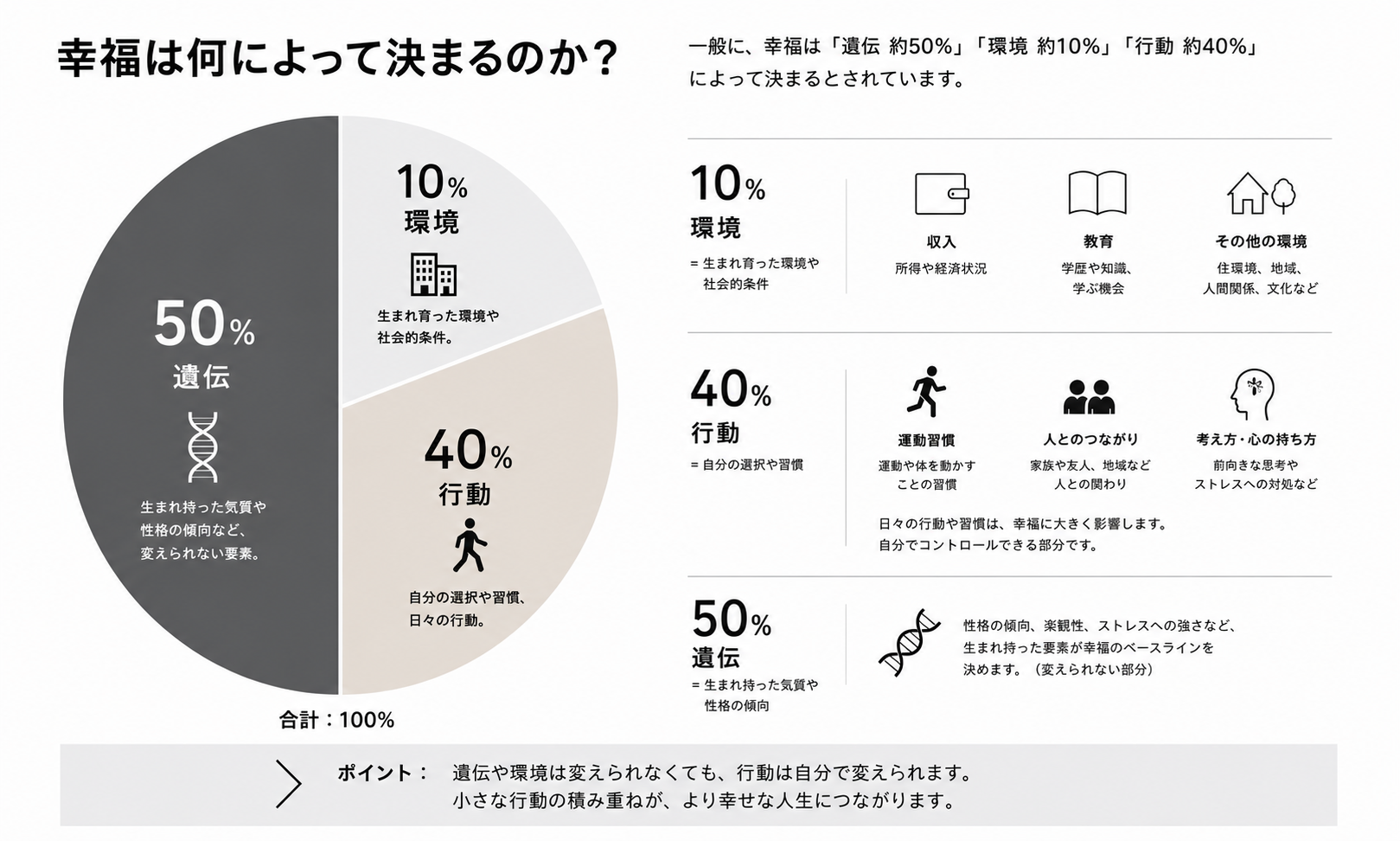
この本で特に印象に残ったのは、幸福の捉え方だ。
一般に幸福は、遺伝が約50%、環境が約10%、そして行動が約40%を占めるとされている。
この数字以上に重要なのは、「行動」にフォーカスしている点だとぼくは思う。
よく動く人
人とよく関わる人
一定のリズムで生活している人
こうしたシンプルな行動が、幸福度や生産性と強く関係している。
つまり、幸福は「考え方」よりも、「どう動いているか」で決まる。
これは直感とは少しズレる。でも、だからこそ価値がある視点だと思う。
そしてぼくは、この考え方は個人の話で終わらせるべきではないと感じた。
どんな行動が良い状態を生むのかを、みんなで共有できるかどうか。
そこに文化の種がある。
運は「行動量」によって増幅される
もう一つ、この本を読んで強く納得したのが「運」の話だ。
ぼくたちはつい、成功や幸福を能力や努力で説明しがちだ。でも実際には、出会いやタイミングといった偶然の影響はかなり大きい。
ここで重要なのは、その運が完全な偶然ではないということ。
よく動く人は、
出会いの回数が増える
試行回数が増える
偶然に触れる確率が上がる
つまり、運に当たる確率そのものが高くなる。
ぼくはここに、この本の本質がある気がしている。
「よく動く人が幸せなのは、ポジティブだから」ではなく、
運に出会う回数が多いからなんじゃないか。
そしてこれは、個人だけの話じゃない。
挑戦することが歓迎される組織
人と関わることが自然に起きる環境
そういう場所では、運そのものが循環する。
逆に、動かない・関わらない環境では、運はほとんど生まれない。
運は性格ではなく、環境と行動でつくられるものだと思う。
ウェアラブルは人を幸せにするのか
じゃあ、その行動を測るウェアラブルは、人を幸せにするのか。
ぼくの考えは、「直接的にはしない。でも、かなり重要な役割はある」。
ウェアラブルは、状態を変えるものではなく、
ズレに気づかせる装置だ。
動いているつもりでも動いていない。
人と関わっているつもりでも孤立している。
そういうズレは、自分ではなかなか気づけない。
データはそれを可視化する。
ただし、当然だけど、見ただけでは何も変わらない。
行動を変えない限り、現実も変わらない。
だからこそ、ウェアラブルの価値は個人というより、
共通理解をつくることにあると思う。
「何が良い状態なのか」を、感覚ではなく言語として共有できる。
それは文化をつくるうえでかなり大きい。
成果は「個人」ではなく「関係性」で生まれる
この本のもう一つの重要なメッセージは、成果は個人ではなく「関係性」で決まるということだ。
誰が優秀かではなく、
誰と誰がどれだけ関わっているか。
会話の量やネットワークの密度が、パフォーマンスに影響する。
ぼくはここに、強い違和感と同時に納得もあった。
これまでの多くの組織は、「個人の能力」を最適化しようとしてきた。でも実際には、「つながり」の方が結果を左右している。
だとしたら、評価すべきものも変わるはずだ。
成果だけでなく、
関係をつくる行動
人をつなぐ動き
そういったものをどう扱うか。
関係性は自然に生まれるものではなく、
設計するものなんだと思う。
データがもたらすのは最適化か、それとも文化か
データによって行動が見えるようになると、「最適化したくなる」のは自然な流れだと思う。
でもぼくは、それだけだと少し物足りないと感じる。
データは、効率を上げるためだけのものじゃない。
どんな行動を良しとするかを定義するためのものでもある。
よく動くことを評価するのか。
人と関わることを価値とするのか。
挑戦することを歓迎するのか。
こうした前提が揃ったとき、初めて文化になる。
行動を設計する時代において
この本を通して、ぼくは一つのシンプルな結論にたどり着いた。
人間の状態は、ある程度までは再現できる。
そしてそれは、日々の行動によって変えられる。
どれだけ動いているか。
誰とどれだけ関わっているか。
どんなリズムで生きているか。
これは個人の問題であると同時に、環境の問題でもある。
だからこそ、
行動は個人任せにするのではなく、文化として設計する必要がある。
『データの見えざる手』は、データの本でありながら、人間の可能性についての本だと思う。
行動を変えれば、状態は変わる。
状態が変われば、結果も変わる。
そして、行動が変われば、出会う運も変わる。
この流れを、個人の努力に任せるのではなく、
どうすれば自然に起きる環境をつくれるのか。
ぼくはそこに、この本の一番の価値があると感じた。
良い状態は偶然では生まれない。
設計され、共有され、繰り返されて、文化になる。
だからこそ、まずはシンプルに。
動くことから始めたい。
さて今日は代々木公園を一周歩くとするか(笑)
株式会社フリックフィットにてChief of Staffを務め、動作OSを活用したウェアラブルデバイス「ardi」の事業に従事。
これまで映画配給会社、出版社でのキャリアを経て、カルチャー・コンテンツとテクノロジー双方の視点から価値創出に取り組んできた。現在はフリックフィットに参画し、人の身体性や感覚に根ざした新たな体験設計に挑戦している。
東京を拠点に未来の人間像を探求する一方、軽井沢では自給自足の暮らしを志向。都市と自然の両極から、人間のあり方そのものを見つめ直す実践を続けている。