
Walking as the Smallest Unit of Decision-Making

Walking is such an ordinary action that we rarely stop to think about how it actually works.
But when we break down a single step, we begin to see just how rationally the human body is designed.
For example, the average person is said to walk around 5,000 to 10,000 steps per day, and roughly 100 to 200 million steps over a lifetime.
In other words, walking is one of the most frequently repeated unconscious “decisions” we make in life.
In this article, we will break walking down from five perspectives and explore why humans are able to move so efficiently.
1. Walking Is Intentional Instability
The essence of walking is not simply maintaining stability.
It is the ability to use instability effectively.
Normally, humans stay balanced by keeping their center of gravity within their base of support — the area supported by the feet.
As long as the center of gravity remains within that base, the body theoretically does not fall.
But during walking, we intentionally move the center of gravity outside that safe zone.
The center of gravity shifts forward by several centimeters, and the body enters a state of controlled falling.
As the body begins to fall forward, the next foot naturally moves out to catch it.
This is a momentum-based strategy.
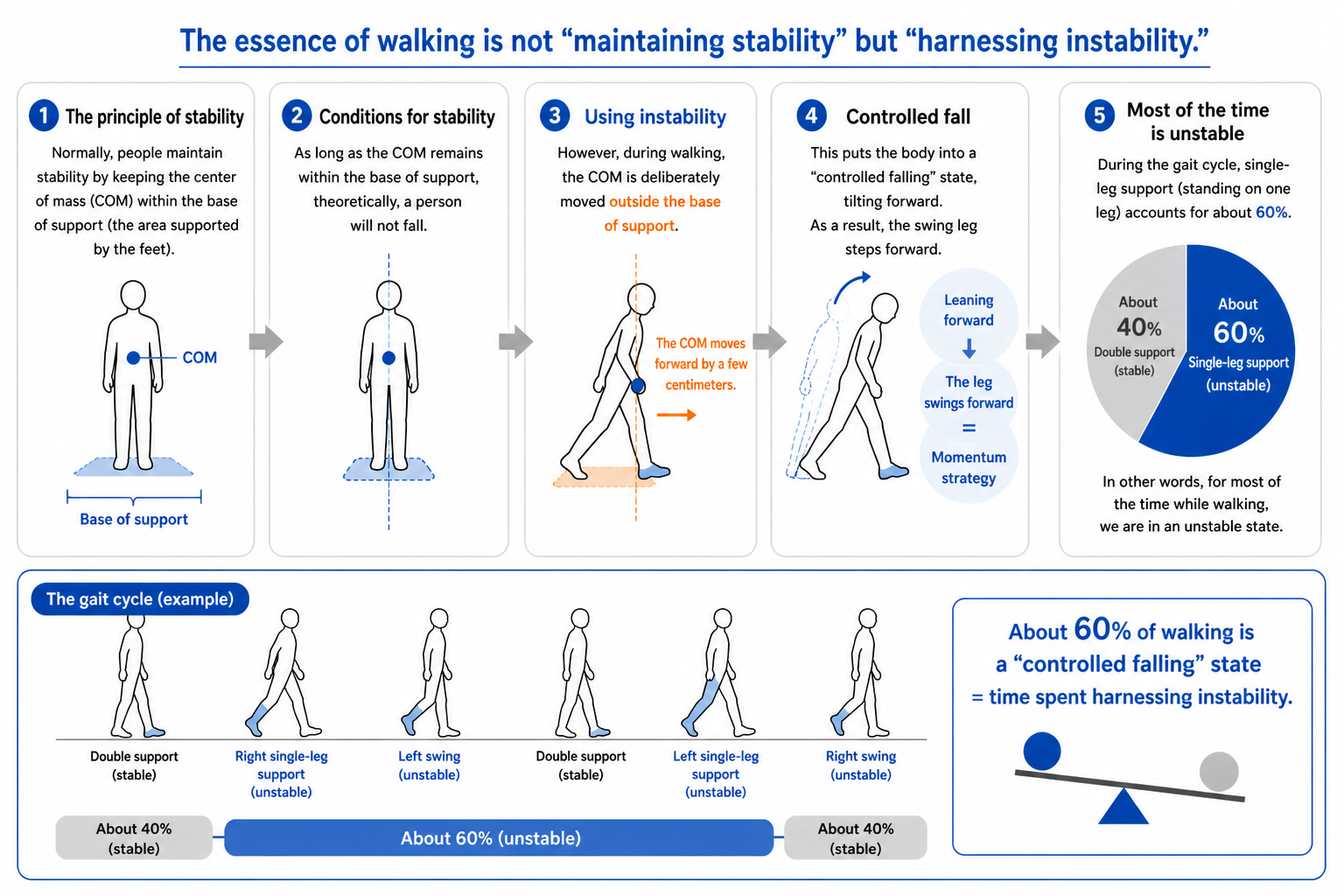
Within the walking cycle, the single-leg support phase — the time spent standing on one leg — accounts for about 60% of the cycle.
In other words, we spend most of our walking time in an unstable state.
On the other hand, the kind of walking often seen in older adults, where the center of gravity is kept from moving too far forward, prioritizes safety.
However, it also makes it harder to generate forward momentum.
So walking can be understood as an optimized behavior:
minimizing risk while intentionally using instability to move forward.
2. Shock Absorption Happens Through a Small Knee Bend
When we walk, the body experiences an impact of about 1.2 times body weight.
For someone who weighs 60 kg, that means each step creates a load of roughly 72 kg.
When this is repeated 10,000 times a day, the joints accumulate a huge amount of repeated stress.
The key mechanism that disperses this load is a small bending movement of the knee.
In simple terms, the body performs a tiny “knee dip” with every step.
This small movement spreads out the impact and minimizes damage to the joints.
After the foot lands, the knee bends slightly — by around 10 to 15 degrees — to absorb shock.
Without this movement, the impact would be transmitted directly to the joints and bones.
This mechanism does not work properly when the knee is locked out, as seen in hyperextended knees.
What matters is that even though the movement is very small, it creates a major difference over time.
10,000 steps per day.
Around 3.65 million steps per year.
Across that repetition, a difference of only a few degrees in joint mobility can affect the long-term lifespan of the joints.
3. Walking Is a Rolling Movement
Walking is not simply a movement powered by pushing with muscle strength.
It is more accurate to think of it as a rolling movement that uses the structure of the foot.
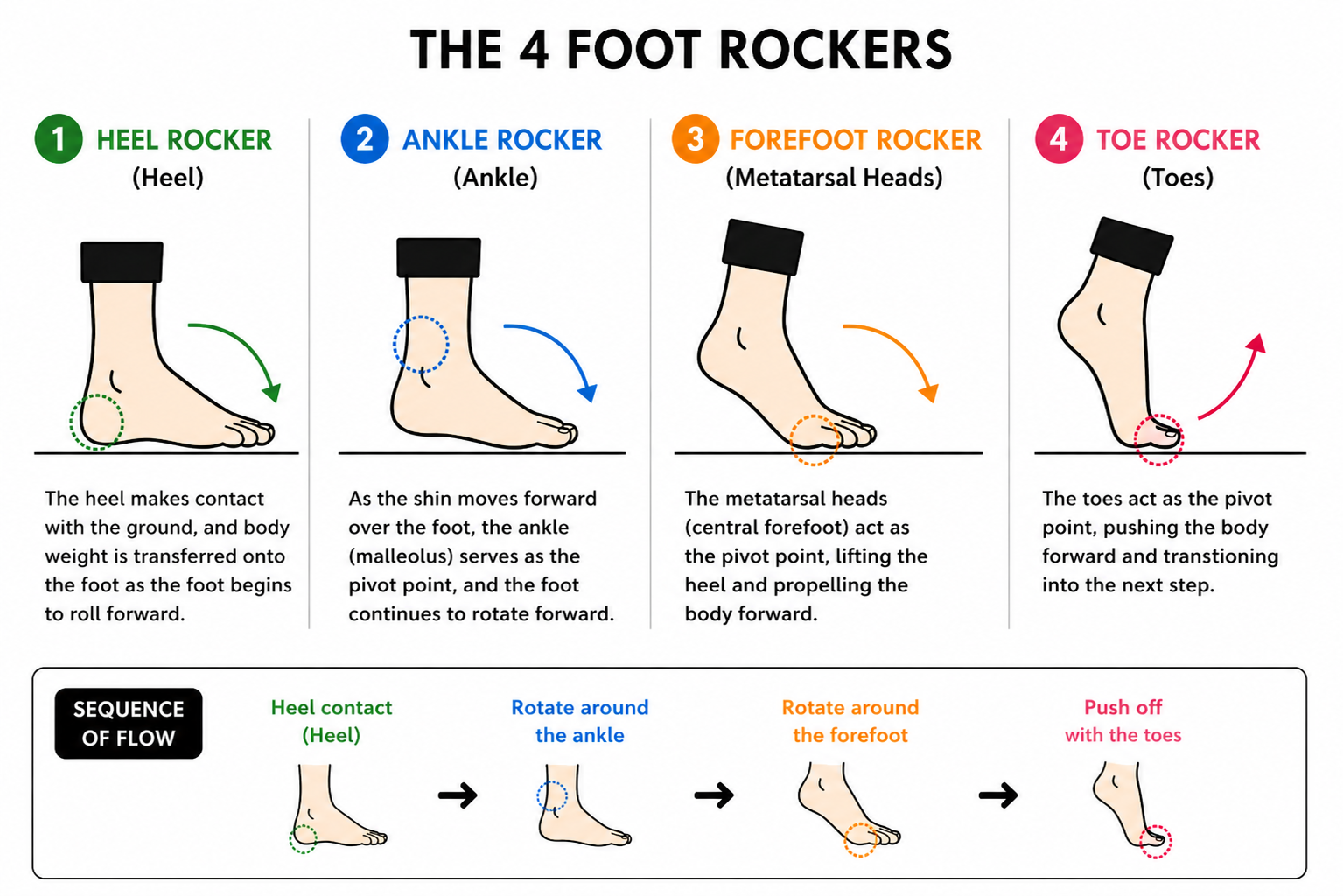
The movement begins with heel contact, then progresses through four stages of support:
Heel rocker — the heel
Ankle rocker — the ankle
Forefoot rocker — the ball of the foot
Toe rocker — the toes
Through these four shifting pivot points, the body moves smoothly forward.
During this process, the ankle dorsiflexes by around 10 degrees, and the toes move through roughly 50 to 60 degrees during push-off.
This allows the body to continuously “roll” forward.
The key point is that the body does not merely absorb impact.
It converts that impact into forward-moving energy.
As a result, the energy cost of walking is kept to around one-third to one-half of the energy cost of running.
4. Walking Has an Optimal Speed
Walking has a speed range where energy efficiency is at its highest.
In general, that speed is around 4.8 km/h, or 1.33 meters per second.
This is only an average for people walking in everyday environments.
The ideal speed varies depending on height, stride length, and body proportions.
At this speed, the typical stride length is around 65 to 75 cm, and the walking cadence is around 100 to 120 steps per minute.
When these conditions come together, walking reaches what could be called its most effortless “magic speed.”
At this speed, the rocker function of the foot works naturally, and unnecessary energy loss is minimized.
On the other hand:
Walking too slowly — below about 1.0 m/s — makes it harder to use the body’s natural walking mechanics efficiently.
Walking too quickly — above about 6 km/h — causes energy consumption to rise sharply.
What is interesting is that racewalking, where the athlete moves quickly while always keeping one foot in contact with the ground, is physiologically very demanding.
In other words, walking is also an optimization system that depends strongly on one key parameter:
speed.
5. Humans Have Some of the Best Endurance in the Animal Kingdom
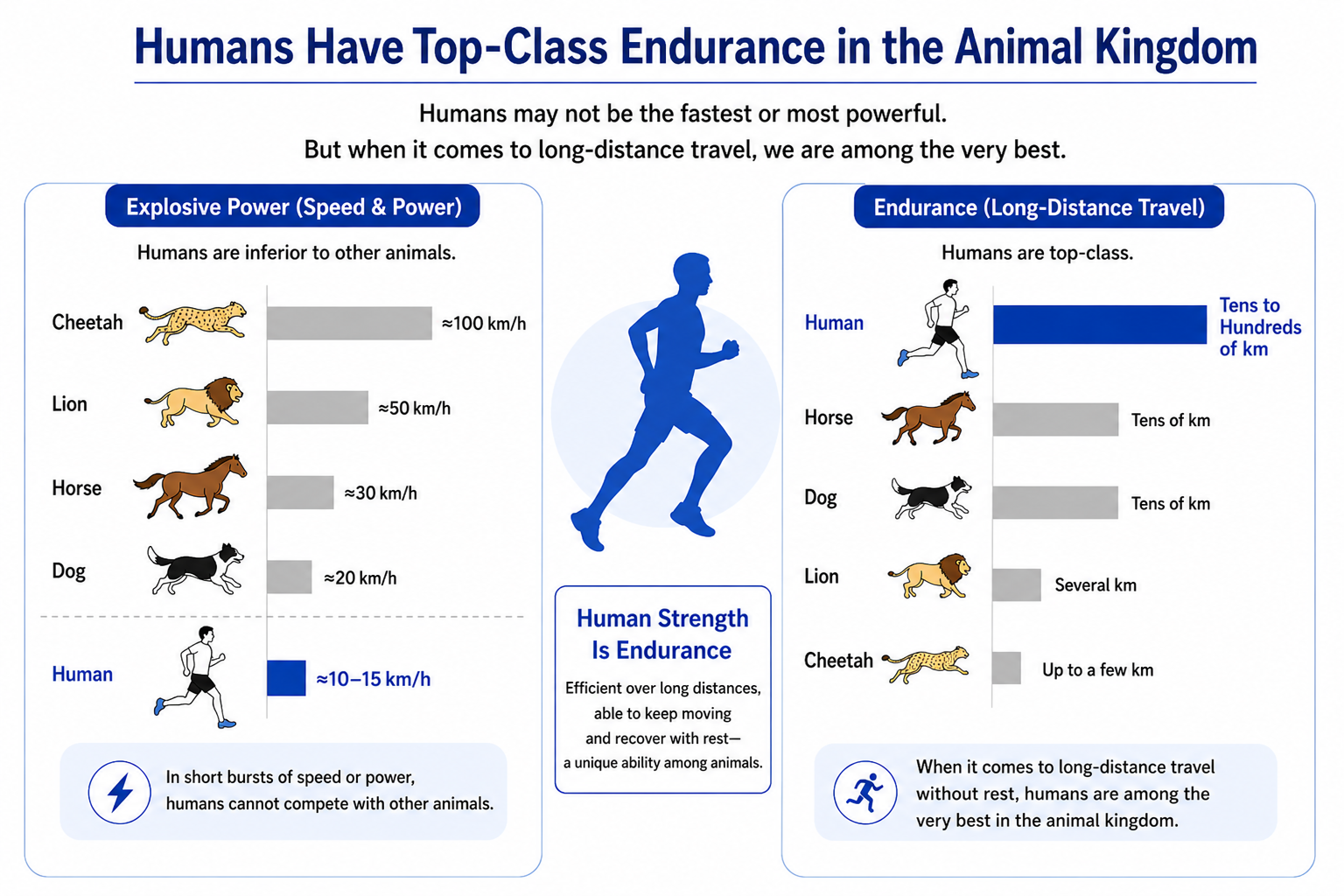
Humans are not superior to many animals when it comes to explosive speed.
But when it comes to long-distance movement, humans are among the best.
The reason lies in the energy efficiency of bipedal walking.
The human body limits vertical movement of the center of gravity to around 5 cm.
It reuses energy through a pendulum-like motion, with an efficiency of around 60 to 70%.
It also stabilizes the upper body, allowing humans to maintain vision and decision-making ability while moving.
Together, these mechanisms allow humans to move for long periods and over long distances.
In hunter-gatherer societies, moving 20 to 40 km per day is often considered common.
Even today, humans are capable of completing full marathons of 42.195 km, as well as ultramarathons exceeding 100 km.
In other words, the human body is optimized less for “moving fast” and more for continuing to move for a long time.
Summary: Walking Is a Concentration of Efficiency
Walking is not just a way to move from one place to another.
It is a highly rational system made up of multiple mechanisms, including:
using instability for forward movement
—single-leg support accounts for about 60% of the walking cycle—
absorbing impact through small movements
—knee flexion of around 10 to 15 degrees—
converting energy through body structure
—with an efficiency of around 60 to 70%—
optimizing movement through speed
—around 4.8 km/h—
And the most important point is this:
all of it happens unconsciously.
Humans repeat this optimization thousands of times every day.
To understand walking is to understand the design philosophy of the human body as a system.